
Regional Terms Anatomy Quiz: Regions of the Human Body
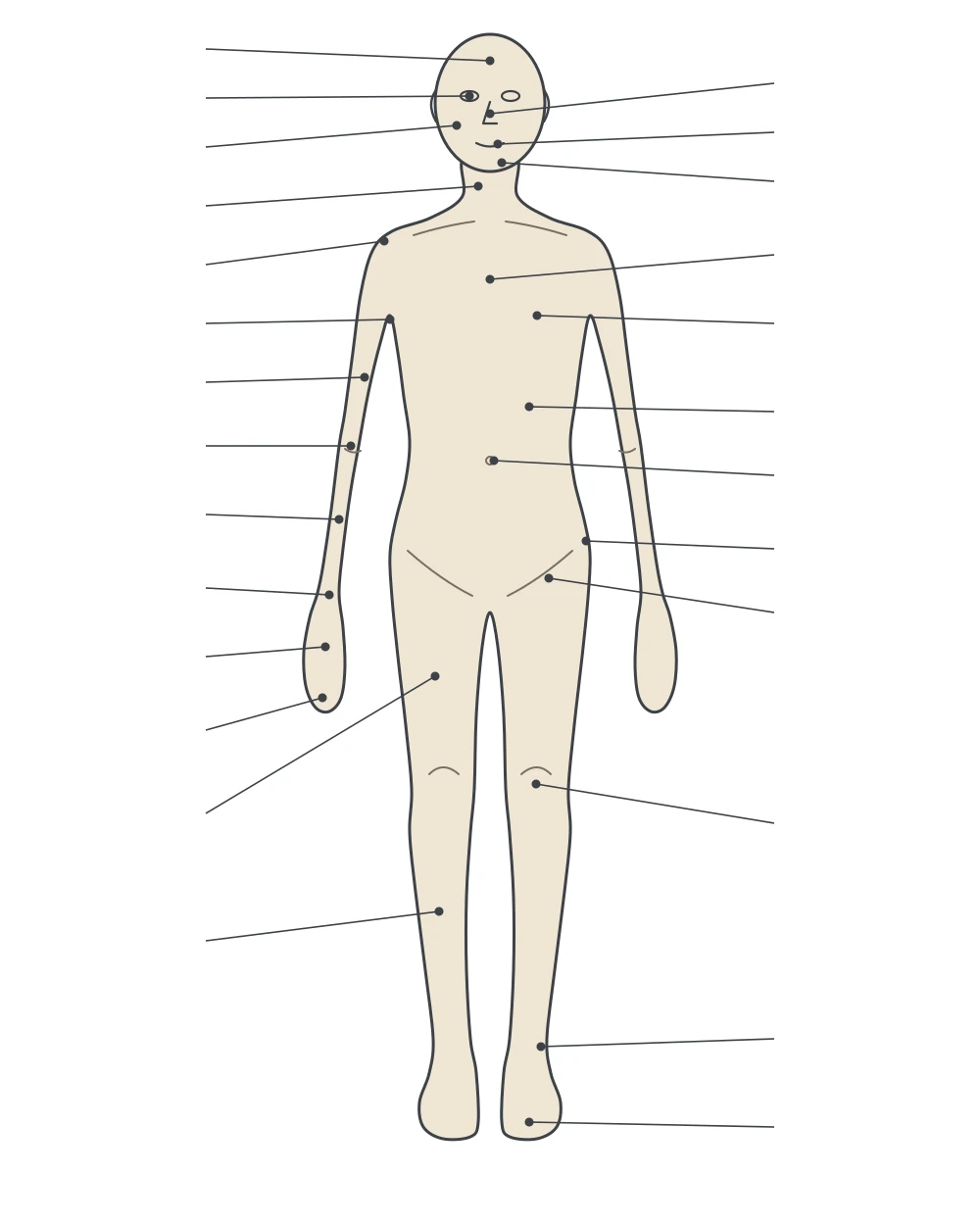
This regional terms anatomy quiz teaches the names anatomists and clinicians use for the regions of the body, such as brachial, femoral or popliteal, on a front and a back view of a simple human figure.

Study
Labels on the anterior (front) view:
- Frontal
- Nasal
- Orbital
- Oral
- Buccal
- Mental
- Cervical
- Sternal
- Acromial
- Axillary
- Thoracic
- Brachial
- Abdominal
- Antecubital
- Umbilical
- Antebrachial
- Coxal
- Carpal
- Inguinal
- Palmar
- Digital
- Femoral
- Patellar
- Crural
- Tarsal
- Pedal
On this page
What this regional terms anatomy quiz covers
Before you can learn bones or muscles, you need the words anatomy uses for places on the body. This quiz drills those regional terms on a simple figure drawn for this site, standing in the anatomical position: upright, facing you, palms forward. Leader lines run from each region to a blank label, and you fill in the name. There are two views:
- Anterior (front): the regions of the face (frontal, orbital, nasal, oral, buccal, mental), the neck and shoulder, the chest and abdomen (sternal, thoracic, abdominal, umbilical), the upper limb from the armpit to the fingers, and the lower limb from the hip and groin down to the foot.
- Posterior (back): the back of the head, the shoulder blades, the spine and lower back (vertebral, lumbar, sacral), the buttocks, the back of the elbow, the back of the knee, the calf and the heel.
There are 36 labels in total. The figure is a plain mannequin on purpose: no muscles, no clothing and no sexual features, so you can concentrate on the names. The terms follow the list of regions used in introductory anatomy and physiology courses.
- Frontal
- The forehead. (anterior (front) view)
- Nasal
- The nose. (anterior (front) view)
- Orbital
- The area around the eye (the orbit). (anterior (front) view)
- Oral
- The mouth. (anterior (front) view)
- Buccal
- The cheek. (anterior (front) view)
- Mental
- The chin (from the Latin mentum). (anterior (front) view)
- Cervical
- The neck. (anterior (front) view)
- Sternal
- The middle of the chest, over the breastbone (sternum). (anterior (front) view)
- Acromial
- The point of the shoulder, over the acromion. (anterior (front) view)
- Axillary
- The armpit (axilla). (anterior (front) view)
- Thoracic
- The chest. (anterior (front) view)
- Brachial
- The upper arm, between the shoulder and the elbow. (anterior (front) view)
- Abdominal
- The front of the trunk between the ribs and the pelvis. (anterior (front) view)
- Antecubital
- The front of the elbow, the usual place for drawing blood. (anterior (front) view)
- Umbilical
- The navel (umbilicus). (anterior (front) view)
- Antebrachial
- The forearm, between the elbow and the wrist. (anterior (front) view)
- Coxal
- The hip. (anterior (front) view)
- Carpal
- The wrist. (anterior (front) view)
- Inguinal
- The groin: the crease where the thigh meets the trunk. (anterior (front) view)
- Palmar
- The palm of the hand. (anterior (front) view)
- Digital
- The fingers (the same term is used for the toes). (anterior (front) view)
- Femoral
- The thigh. (anterior (front) view)
- Patellar
- The front of the knee, over the kneecap (patella). (anterior (front) view)
- Crural
- The front of the leg, between the knee and the ankle. (anterior (front) view)
- Tarsal
- The ankle. (anterior (front) view)
- Pedal
- The foot. (anterior (front) view)
- Occipital
- The back of the head. (posterior (back) view)
- Scapular
- The shoulder blade area, over the scapula. (posterior (back) view)
- Vertebral
- The area over the spine (vertebral column). (posterior (back) view)
- Olecranal
- The back of the elbow, over the olecranon. (posterior (back) view)
- Lumbar
- The lower back, between the ribs and the pelvis. (posterior (back) view)
- Sacral
- The area between the hips, over the sacrum. (posterior (back) view)
- Gluteal
- The buttock. (posterior (back) view)
- Popliteal
- The hollow at the back of the knee. (posterior (back) view)
- Sural
- The calf, the back of the leg below the knee. (posterior (back) view)
- Calcaneal
- The heel, over the calcaneus. (posterior (back) view)
How to learn the regional terms
- Learn the roots, not just the words. Many terms come from the Latin name of a bone or body part: brachium (arm), femur (thigh), carpus (wrist), tarsus (ankle), patella (kneecap), calcaneus (heel). Once you know the root, the adjective follows: brachial, femoral, carpal, tarsal, patellar, calcaneal.
- Watch the prefixes. Ante- means "before" or "in front of": the antebrachium is the forearm, and antecubital is the front of the elbow (cubitus is Latin for elbow).
- Pair front and back. Several regions come in front–back pairs: antecubital and olecranal at the elbow, patellar and popliteal at the knee, crural and sural on the leg, palmar on the hand and plantar on the sole of the foot.
- Work from head to toe. Do one view in Study mode, saying each term aloud from the top down, then switch to Label it. Head-to-toe order turns the list into a route you can walk mentally.
- Use the terms with real structures. The same roots name bones and muscles: the femoral region holds the femur, the brachial region the brachialis and biceps brachii. When you move on to the skeletal system quiz or the muscle quiz, the regional names will already be familiar.
Common mistakes
- Buccal versus oral. Buccal is the cheek; oral is the mouth itself.
- Mental is the chin. It comes from the Latin mentum, chin, and has nothing to do with the mind.
- Crural versus sural. Crural is the leg in general and its front (the shin side); sural is the calf at the back.
- Coxal versus inguinal. Coxal is the hip, at the side; inguinal is the groin, the crease at the front where the thigh joins the trunk.
- Carpal and tarsal. Carpal is the wrist; tarsal is the ankle. The same pair appears in the names of the bones: carpals in the hand, tarsals in the foot.
Keep going
Regional terms come back in every chapter of anatomy. Put them to work on the skeleton with the bones quiz, where the femur, humerus and other bones sit in the regions named after them.
Printable worksheets
Prefer paper? Each of the 2 views of this quiz comes as a free one-page PDF worksheet: the same plate with every label hidden under a blank numbered box, and a numbered line to write each name. A matching answer key lists the names with the same numbers as the quiz above.
How to use it: study the plate on screen first, then print the worksheet and fill in every line from memory. Mark it with the answer key and circle the ones you missed. A day or two later, print a fresh copy and do only the circled numbers, or switch to Type it above, which asks for the names in the same order.
- Anterior (front) view: Worksheet · A4 · Answer key · A4
- Posterior (back) view: Worksheet · A4 · Answer key · A4
Frequently asked questions
- What are regional terms in anatomy?
- Regional terms are the names for areas of the body surface, mostly adjectives built from Latin or Greek roots: brachial for the upper arm, femoral for the thigh, popliteal for the back of the knee. They let anatomists and clinicians name a place on the body precisely, for example "a wound in the left antecubital region".
- Why do anatomists use regional terms instead of everyday words?
- Everyday words are vague and differ between languages and regions. Arm, for example, can mean the whole upper limb or only the part above the elbow. The regional terms have one meaning each, so a note written by one nurse or doctor is understood the same way by everyone else.
- What is the difference between brachial and antebrachial?
- Brachial refers to the upper arm, between the shoulder and the elbow. Antebrachial (literally "before the arm") refers to the forearm, between the elbow and the wrist. The same prefix appears in antecubital, the front of the elbow.
- What is the anatomical position?
- The reference posture used for every description in anatomy: standing upright, facing forward, feet together and arms at the sides with the palms facing forward. The figure in this quiz stands in that position, so the thumbs point away from the body.
- Is the figure in this quiz an anatomical drawing?
- It is a simple, neutral mannequin drawn for this site, without sexual features, so the quiz can focus on the names of the regions. The leader lines point to the center of each region; the borders between regions are not exact lines on the real body.
Sources
- OpenStax, Anatomy and Physiology 2e, section 1.6: Anatomical Terminology (Figure 1.12, Regions of the Human Body)
- Federative International Programme for Anatomical Terminology (FIPAT), Terminologia Anatomica, 2nd ed. (2019), TA2 Viewer
Image credits
- Anterior (front) view: Illustration: Anatomy Quiz Lab (own work).
- Posterior (back) view: Illustration: Anatomy Quiz Lab (own work).
Licenses, sources and changes for every illustration are listed on the image credits page.