
Scapula Labeling Quiz: Borders, Angles, Fossae and Processes
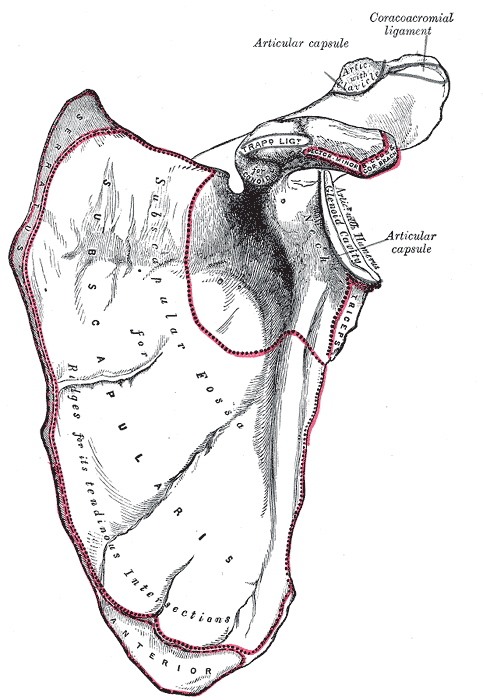
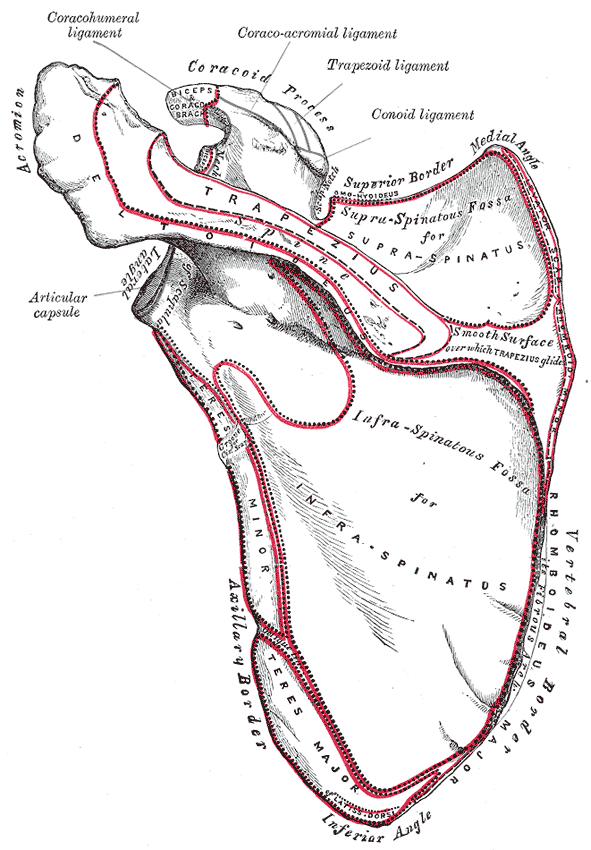
This scapula labeling quiz covers the landmarks of the shoulder blade on its front and back surfaces, using two plates from Henry Gray's Anatomy of the Human Body (1918).


Study
Labels on the anterior (costal) surface view:
- Acromion
- Coracoid process
- Suprascapular notch
- Superior border
- Superior angle
- Glenoid cavity
- Neck of scapula
- Subscapular fossa
- Medial border
- Lateral border
- Inferior angle
On this page
What this scapula labeling quiz covers
The scapula, or shoulder blade, is the flat triangular bone at the back of the chest wall that links the arm to the trunk. Learning it comes down to a short list of landmarks: three borders, three angles, the fossae on each surface, the spine and two processes. This quiz splits them between two views, which you can switch with the tabs above the plate:
- Anterior (costal) surface: the side that faces the ribs. You label the subscapular fossa, the glenoid cavity and the neck behind it, the coracoid process and the acromion at the top, the suprascapular notch, and the borders and angles that frame the bone.
- Posterior surface: the side you can feel under the skin of the back. Here the spine of the scapula crosses the bone and splits it into the supraspinous fossa above and the infraspinous fossa below; you also label the borders, the superior and inferior angles, the acromion and the coracoid process.
There are 21 labels in total. The 1918 plates print some landmarks with older names, such as vertebral border, axillary border, medial angle and supraspinatous fossa; the quiz asks for the current name and Type it accepts the old one. On the anterior plate Gray prints only a few landmark names, so the borders, angles and processes there are marked with boxes placed directly on the bone. The red outlines on both plates show where muscles attach; their names stay visible, except those that would give away the name of a fossa.
- Acromion
- The flat projection at the top of the spine of the scapula that forms the point of the shoulder. It joins the clavicle at the acromioclavicular joint.
- Coracoid process
- A hook-shaped process that points forward from the upper border, just below the clavicle. The pectoralis minor, the short head of the biceps and the coracobrachialis attach to it.
- Suprascapular notch
- A notch in the superior border, just medial to the base of the coracoid process. The suprascapular nerve passes through it. (anterior (costal) surface view)
- Superior border
- The shortest and thinnest border of the scapula, running from the superior angle to the base of the coracoid process.
- Superior angle
- The upper corner of the scapula, where the superior and medial borders meet. The levator scapulae attaches here.
- Glenoid cavity
- The shallow oval socket on the lateral angle of the scapula that receives the head of the humerus, forming the shoulder joint. (anterior (costal) surface view)
- Neck of scapula
- The slightly narrowed part of the scapula just behind the glenoid cavity. (anterior (costal) surface view)
- Subscapular fossa
- The broad hollow that makes up most of the front (costal) surface of the scapula. It is filled by the subscapularis muscle. (anterior (costal) surface view)
- Medial border
- The long border nearest the spine (the vertebral column), from the superior angle to the inferior angle. The rhomboid muscles attach to it.
- Lateral border
- The thick border nearest the armpit, running from the glenoid cavity down to the inferior angle.
- Inferior angle
- The lowest point of the scapula, where the medial and lateral borders meet. It lies over the seventh rib and is easy to feel through the skin.
- Supraspinous fossa
- The smaller hollow on the back of the scapula above the spine. The supraspinatus muscle arises from it. (posterior surface view)
- Spine of scapula
- The prominent ridge that crosses the back of the scapula and ends laterally in the acromion. It separates the supraspinous fossa from the infraspinous fossa. (posterior surface view)
- Infraspinous fossa
- The large hollow on the back of the scapula below the spine. The infraspinatus muscle arises from most of it. (posterior surface view)
How to learn the scapula
- Start with the triangle. Find the three angles first: superior at the top inner corner, inferior at the bottom tip and lateral at the glenoid cavity. The borders are simply the lines between them: superior between the superior angle and the coracoid, medial down the side nearest the spine, lateral from the glenoid cavity to the inferior angle.
- Orient yourself with the processes. The acromion and the coracoid process are both at the top, near the shoulder joint. The acromion continues the spine on the back; the coracoid points forward like a bent finger. If you see the spine, you are looking at the back.
- Name the fossae after their muscles. Subscapularis in front, supraspinatus above the spine, infraspinatus below it. Learn the muscle and you have the fossa.
- Tell left from right. In both plates the bone is a left scapula. The glenoid cavity always points to the side, away from the spine, so it is on the right of the drawing in the front view and on the left in the back view.
- Combine with the whole skeleton. The scapula is part of the shoulder (pectoral) girdle; see how it sits on the back of the ribs with the clavicle in the appendicular skeleton quiz.
Common mistakes
- Medial versus lateral border. In anatomical position the medial border faces the spine and the lateral border faces the armpit. On the plates the scapula is a left one, so mirror the drawing in your head if you study on your own right shoulder.
- Superior angle versus acromion. Both are at the top, but the superior angle is the inner corner of the blade, far from the shoulder joint; the acromion is the outer end of the spine, right over the joint.
- Glenoid cavity versus glenoid fossa of the temporal bone. The jaw joint has a similarly named mandibular (glenoid) fossa on the skull. On the scapula, the glenoid cavity holds the humerus.
- Spine versus superior border. The spine is the thick ridge across the back; the superior border is the thin upper edge of the blade, above the supraspinous fossa.
Keep going
The scapula is full of named bumps and grooves, and the same naming rules apply across the skeleton. Practice the general terms, such as fossa, process, tubercle and notch, in the bone markings quiz.
Printable worksheets
Prefer paper? Each of the 2 views of this quiz comes as a free one-page PDF worksheet: the same plate with every label hidden under a blank numbered box, and a numbered line to write each name. A matching answer key lists the names with the same numbers as the quiz above.
How to use it: study the plate on screen first, then print the worksheet and fill in every line from memory. Mark it with the answer key and circle the ones you missed. A day or two later, print a fresh copy and do only the circled numbers, or switch to Type it above, which asks for the names in the same order.
- Anterior (costal) surface view: Worksheet · A4 · Answer key · A4
- Posterior surface view: Worksheet · A4 · Answer key · A4
Frequently asked questions
- What are the main parts of the scapula?
- The scapula is a flat, triangular bone with three borders (superior, medial and lateral), three angles (superior, inferior and lateral, which carries the glenoid cavity) and two surfaces. The front surface is the subscapular fossa; the back is divided by the spine into the supraspinous and infraspinous fossae. Two processes stick out from it: the acromion at the end of the spine and the coracoid process at the front.
- What is the difference between the acromion and the coracoid process?
- The acromion is the flat end of the spine of the scapula; it forms the point of the shoulder and joins the clavicle. The coracoid process is a smaller, hook-shaped projection that points forward, below the clavicle, and gives attachment to muscles and ligaments rather than forming a joint.
- Which border of the scapula is the vertebral border?
- The medial border, the long border closest to the spine. Older books call it the vertebral border and call the lateral border the axillary border, because it faces the armpit (axilla). The quiz accepts both names when you type.
- What muscles attach to the fossae of the scapula?
- Each fossa is named after the muscle that fills it: the subscapularis in the subscapular fossa on the front, the supraspinatus above the spine and the infraspinatus below it. Together with the teres minor, these muscles form the rotator cuff.
- Where is the glenoid cavity?
- On the lateral angle of the scapula, facing outward. It is the shallow socket that holds the head of the humerus. Because it is so shallow, the shoulder moves freely but dislocates more easily than the hip.
Sources
- Henry Gray, Anatomy of the Human Body, 20th ed., ed. W. H. Lewis (Philadelphia: Lea & Febiger, 1918), Osteology: The Scapula, Figs. 202 and 203
- Federative International Programme for Anatomical Terminology (FIPAT), Terminologia Anatomica, 2nd ed. (2019), TA2 Viewer
- OpenStax, Anatomy and Physiology 2e, section 8.1: The Pectoral Girdle
Image credits
- Anterior (costal) surface view: Illustration: Henry Gray, Anatomy of the Human Body (1918), public domain, via Wikimedia Commons.
- Posterior surface view: Illustration: Henry Gray, Anatomy of the Human Body (1918), public domain, via Wikimedia Commons.
Licenses, sources and changes for every illustration are listed on the image credits page.