
Skeletal System Quiz: Functions, Bone Types and Divisions
This skeletal system quiz draws 10 questions at random from a bank of more than 30 on what bones do, how they are classified, how a long bone is built and how the skeleton is divided.
10 random questions from a bank of 31
On this page
What this skeletal system quiz covers
This is a multiple-choice quiz, not a labeling one. Each round picks 10 questions at random from a bank of 31, so every round is a little different. After you answer, the quiz shows the right option and a short explanation of why it is right; at the end you get your score, a review of every question you missed and a button to retry only those questions. Your best score is saved in this browser.
The questions cover five topics that come up in almost every introductory anatomy and physiology course:
- Functions of the skeleton: support, protection, movement, storage of minerals and fat, and blood cell production.
- Bone classification: long, short, flat, irregular and sesamoid bones, with typical examples of each.
- Structure of a long bone: diaphysis, epiphyses, epiphyseal plate and line, medullary cavity, periosteum, endosteum, articular cartilage and nutrient foramen.
- Bone tissue: compact and spongy bone, osteons and trabeculae, and the cells that build, maintain and remove bone.
- Divisions of the skeleton: which bones belong to the axial and to the appendicular skeleton, plus the numbers that are often asked on tests.
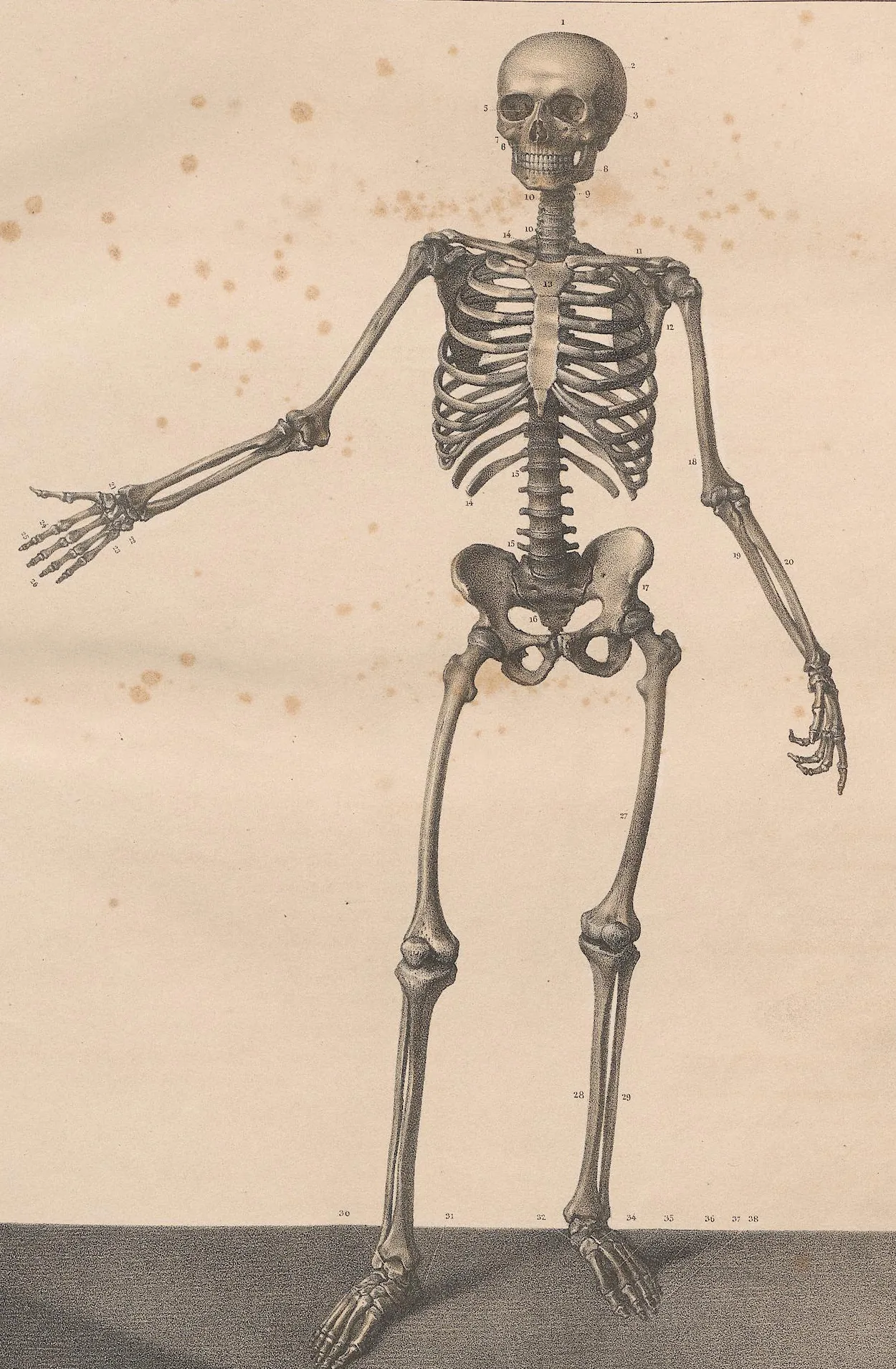
The illustration beside the questions is a complete skeleton seen from the front, from a nineteenth-century anatomical atlas. Use it to picture the two divisions: the skull, spine, ribs and sternum down the middle form the axial skeleton; the girdles and limbs form the appendicular skeleton.
How to study the skeletal system
- Learn the functions as a list of five verbs. Support, protect, move, store and make (blood cells). When a question asks which item is not a function, check each option against the list.
- Classify by shape, not by size. Ask two questions: is it longer than it is wide, with a shaft? Then it is a long bone, even a fingertip. Is it about as long as it is wide? Then it is a short bone. Thin and curved means flat; odd-shaped means irregular; inside a tendon means sesamoid.
- Draw a long bone once. Sketch a femur cut lengthwise and label the shaft, the two ends, the growth plate, the marrow cavity and the two membranes. Drawing the parts in place makes the vocabulary stick far better than reading a list.
- Pair each bone cell with one verb. Osteoblasts build, osteoclasts break down, osteocytes maintain, and osteogenic cells divide to supply new osteoblasts.
- Use the girdles to sort the divisions. The clavicle and scapula (pectoral girdle) and the hip bones (pelvic girdle) belong to the appendicular skeleton, even though they sit close to the trunk. The sacrum and the coccyx, between the hip bones, are part of the axial skeleton.
Common mistakes
- Mixing up red and yellow marrow. Red marrow makes blood cells; yellow marrow is mostly fat. In adults, the medullary cavity of long bones holds yellow marrow.
- Periosteum versus endosteum. The periosteum covers the outside of the bone; the endosteum lines the inside of the medullary cavity. Joint surfaces have neither: they are covered by articular cartilage.
- Calling the pelvis entirely appendicular. The pelvic girdle is the two hip bones; the bony pelvis also includes the sacrum and coccyx, which are axial.
- Counting the ribs as all alike. Ribs 1 to 7 are true ribs, 8 to 12 are false ribs, and 11 and 12 are also floating ribs.
When the concepts are clear, practice naming the bones themselves in the bones quiz, or go division by division with the axial skeleton quiz and the appendicular skeleton quiz.
Printable question sheet
Prefer paper? All 31 questions of the bank fit on a free PDF question sheet with a box to tick for each option, and the answer key gives the right letter with the same short explanation the online quiz shows.
Answer the whole sheet in one sitting, then mark it with the key and note the topics you missed. Go back to those parts of the page above, and a few days later try the online rounds of 10 random questions to see whether the mistakes are gone.
- All 31 questions: Question sheet · A4 · Answer key · A4
Frequently asked questions
- How many bones are in the human body?
- A typical adult skeleton has 206 bones: 80 in the axial skeleton and 126 in the appendicular skeleton. A newborn has more separate bony parts, because many bones start as several pieces that fuse during childhood.
- What is the difference between the axial and the appendicular skeleton?
- The axial skeleton is the central column of the body: the skull, the ear ossicles, the hyoid, the vertebral column and the thoracic cage. The appendicular skeleton is everything attached to it: the upper and lower limbs plus the pectoral and pelvic girdles that connect them to the trunk.
- Is bone living tissue?
- Yes. Bone has blood vessels and nerves, and its cells constantly remodel it: osteoclasts remove old matrix while osteoblasts lay down new matrix. That is why bones heal after a fracture and respond to exercise.
- Where does a bone grow in length?
- During childhood and adolescence, long bones lengthen at the epiphyseal (growth) plates, layers of cartilage between the shaft and each end. When growth stops, each plate is replaced by bone and leaves a thin epiphyseal line.
- Why are finger bones called long bones when they are so small?
- Bone type depends on shape, not size. A phalanx is longer than it is wide and has a shaft with two ends, so it counts as a long bone, just like the femur.
Sources
- OpenStax, Anatomy and Physiology 2e, chapter 6: Bone Tissue and the Skeletal System
- OpenStax, Anatomy and Physiology 2e, section 7.1: Divisions of the Skeletal System
- Henry Gray, Anatomy of the Human Body, 20th ed. (1918), Osteology
Image credits
- Illustration: J.-M. Bourgery and N.-H. Jacob, Traité complet de l'anatomie de l'homme (1831–1854), public domain, via Wikimedia Commons. Digitization: Heidelberg University Library.
Licenses, sources and changes for every illustration are listed on the image credits page.