
Cranial Nerves Quiz: Names, Numbers and Where They Leave the Brain
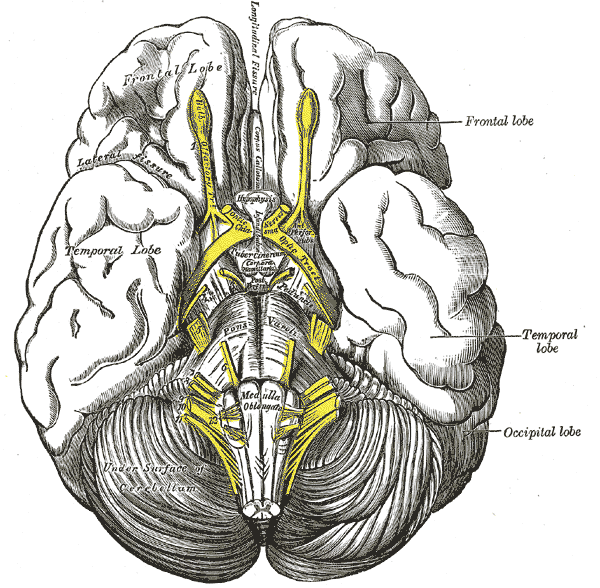
This cranial nerves quiz asks you to find all twelve pairs on the underside of the brain and to match each nerve with its number, using a plate from Henry Gray's Anatomy of the Human Body (1918).

Study
Labels on the base of the brain view:
- Olfactory bulb (cranial nerve I)
- Optic nerve
- Oculomotor nerve
- Trochlear nerve
- Trigeminal nerve
- Abducens nerve
- Facial nerve
- Vestibulocochlear nerve
- Glossopharyngeal nerve
- Vagus nerve
- Accessory nerve
- Hypoglossal nerve
On this page
What this cranial nerves quiz covers
The quiz uses one plate: the underside of the brain, as you would see it if you lifted the brain out of the skull and turned it over. The front of the brain is at the top. In the original drawing the nerves are colored yellow, which makes them easy to follow from the point where each one leaves the brain.
There are 12 labels, one for each pair of cranial nerves, and label N is always cranial nerve N. Label 1 is the olfactory bulb: the olfactory nerve itself is a bundle of fine threads that runs from the nose into the bulb and is too small to draw on the base of the brain, so the bulb stands for cranial nerve I. The olfactory bulb and the optic nerve are labeled where their names are printed on the plate. For nerves III to XII the 1918 drawing uses only small numbers on the left half of the brain; the quiz boxes sit on those numbers or a little further along the same nerve, so that neighboring labels don't overlap. A few printed labels that would give away an answer, such as Optic Tract, are covered. Labels for other parts of the brain, like the pons, tuber cinereum or medulla oblongata, stay visible to help you find your way.
Besides the usual modes, this quiz has a Numbers round: half the questions give you a number and ask for the nerve, and the other half give you the nerve and ask for its number. Each right answer marks that nerve on the plate.
- Olfactory bulb (cranial nerve I)
- The olfactory bulb, where cranial nerve I, the nerve of smell, ends. The olfactory nerve itself is a set of fine threads that pass up from the nose through the roof of the nasal cavity into the bulb; the olfactory tract carries the signals back from the bulb to the brain.
- Optic nerve
- Cranial nerve II, the nerve of sight. It carries signals from the retina; the two optic nerves meet at the optic chiasm, where half of the fibers cross to the other side.
- Oculomotor nerve
- Cranial nerve III. It leaves the midbrain between the cerebral peduncles and moves most of the eye muscles, raises the upper eyelid and narrows the pupil.
- Trochlear nerve
- Cranial nerve IV, the thinnest cranial nerve and the only one that leaves the back of the brainstem. It winds around the cerebral peduncle and supplies the superior oblique muscle of the eye.
- Trigeminal nerve
- Cranial nerve V, the largest cranial nerve. It leaves the side of the pons, carries sensation from the face, scalp, teeth and mouth, and moves the chewing muscles.
- Abducens nerve
- Cranial nerve VI. It leaves the brainstem between the pons and the medulla, close to the midline, and supplies the lateral rectus muscle, which turns the eye outward.
- Facial nerve
- Cranial nerve VII. It leaves the brainstem where the pons meets the medulla, moves the muscles of facial expression and carries taste from the front of the tongue.
- Vestibulocochlear nerve
- Cranial nerve VIII, the nerve of hearing and balance. It enters the brainstem just beside the facial nerve; Gray's 1918 edition calls it the acoustic nerve.
- Glossopharyngeal nerve
- Cranial nerve IX. Its rootlets leave the side of the medulla; it carries taste and sensation from the back of the tongue and throat and helps you swallow.
- Vagus nerve
- Cranial nerve X, the longest cranial nerve. It leaves the medulla just below the glossopharyngeal nerve and reaches the throat, voice box, heart, lungs and most of the gut.
- Accessory nerve
- Cranial nerve XI. Most of its fibers come from the upper spinal cord and run up beside the medulla; it supplies the sternocleidomastoid and trapezius muscles.
- Hypoglossal nerve
- Cranial nerve XII. A row of rootlets leaves the medulla between the pyramid and the olive; it moves the muscles of the tongue.
How to learn the cranial nerves
- Learn the order first. The nerves are numbered roughly from front to back, in the order they leave the brain. A classic memory aid for the names is "Oh, Oh, Oh, To Touch And Feel Very Good Velvet, Ah, Heaven": olfactory, optic, oculomotor, trochlear, trigeminal, abducens, facial, vestibulocochlear, glossopharyngeal, vagus, accessory, hypoglossal.
- Then learn what kind of nerve each one is. "Some Say Marry Money, But My Brother Says Big Brains Matter More" gives sensory (S), motor (M) or both (B) for nerves I to XII in order.
- Group them by where they leave the brain. I and II connect to the forebrain. III and IV come from the midbrain. V leaves the side of the pons. VI, VII and VIII leave at the border between the pons and the medulla. IX, X, XI and XII leave the medulla. On the plate you can see this as a line of nerves running from the top of the drawing down to the medulla.
- Tie the eye nerves together. Three nerves move the eye: III supplies most of the eye muscles, IV only the superior oblique and VI only the lateral rectus. The eye anatomy quiz shows the lateral and medial rectus on each side of the eyeball.
- Use the Numbers round daily. Number-to-name questions are quick, and a few rounds a day fix the order in memory much faster than rereading a list.
Common mistakes
- Trochlear versus trigeminal. Both start with "tr". The trochlear (IV) is the thinnest nerve and moves one eye muscle; the trigeminal (V) is the thickest and carries sensation from the whole face.
- Facial nerve and facial sensation. The facial nerve (VII) moves the muscles of facial expression, but the skin of the face is supplied by the trigeminal nerve (V).
- Glossopharyngeal versus hypoglossal. Both reach the tongue. The glossopharyngeal (IX) carries taste and sensation from the back of the tongue; the hypoglossal (XII) moves the tongue.
- Vestibulocochlear under an old name. Older books, including Gray's 1918 edition, call nerve VIII the acoustic or auditory nerve. Type it accepts those names, but the current one is vestibulocochlear.
- Optic nerve, chiasm and tract. Only the part in front of the chiasm is the optic nerve; behind the chiasm the fibers continue as the optic tract.
Keep going
The cranial nerves leave the skull through openings in its base; see the bones they pass through in the skull labeling quiz, or review the parts of the brain they connect to in the brain anatomy quiz.
Printable worksheets
Prefer paper? Each view of this quiz comes as a free one-page PDF worksheet: the same plate with every label hidden under a blank numbered box, and a numbered line to write each name. A matching answer key lists the names with the same numbers as the quiz above.
How to use it: study the plate on screen first, then print the worksheet and fill in every line from memory. Mark it with the answer key and circle the ones you missed. A day or two later, print a fresh copy and do only the circled numbers, or switch to Type it above, which asks for the names in the same order.
- Base of the brain view: Worksheet · A4 · Answer key · A4
Frequently asked questions
- What are the 12 cranial nerves in order?
- I olfactory, II optic, III oculomotor, IV trochlear, V trigeminal, VI abducens, VII facial, VIII vestibulocochlear, IX glossopharyngeal, X vagus, XI accessory and XII hypoglossal. The numbers follow the order in which the nerves leave the brain, from front to back.
- Which cranial nerves are sensory, motor or both?
- Three are purely sensory: olfactory (I), optic (II) and vestibulocochlear (VIII). Five are mainly motor: oculomotor (III), trochlear (IV), abducens (VI), accessory (XI) and hypoglossal (XII). Four are mixed: trigeminal (V), facial (VII), glossopharyngeal (IX) and vagus (X).
- Why are the cranial nerves numbered with Roman numerals?
- It is a long-standing convention. The twelve-pair numbering used today goes back to the late 18th century, and the numbers simply run from the front of the brain to the back. Roman numerals keep the nerve numbers apart from other numbers in anatomy, such as vertebrae and ribs.
- Which cranial nerve leaves the back of the brainstem?
- The trochlear nerve (IV). It is the only cranial nerve that emerges from the dorsal side of the brainstem, just below the inferior colliculi, and then winds forward around the cerebral peduncle. That is why on a view of the base of the brain you only see it at the side of the peduncle.
- Which is the longest cranial nerve?
- The vagus nerve (X). It leaves the medulla oblongata, passes through the neck beside the carotid artery and reaches the heart, the lungs and most of the digestive tract in the abdomen.
Sources
- Henry Gray, Anatomy of the Human Body, 20th ed., ed. W. H. Lewis (Philadelphia: Lea & Febiger, 1918), Neurology: The Brain, Fig. 724
- Federative International Programme for Anatomical Terminology (FIPAT), Terminologia Anatomica, 2nd ed. (2019), TA2 Viewer
- OpenStax, Anatomy and Physiology 2e, section 13.4: The Peripheral Nervous System
Image credits
- Base of the brain view: Illustration: Henry Gray, Anatomy of the Human Body (1918), public domain, via Wikimedia Commons.
Licenses, sources and changes for every illustration are listed on the image credits page.